
Religious leaders strengthen their commitment against HIV and AIDS
Claudia Florentín and ALC/CLAI, BUENOS AIRES, Argentina, April 17, 2007
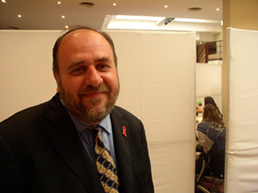
“I am satisfied with the opening of hearts,” said Elías Szczytnicki, Director of the Latin Taxi Heathrow Airport American and Caribbean Regional Office of the World Conference of Religions for Peace (WCRP), during the Ecumenical and Inter-Religious Pre-Forum of the IV Latin American and Caribbean Forum on HIV/AIDS and ITS, that took place today in AMIA, a Jewish community in Buenos Aires.
"We have all come with an awareness that diversity is the central axis and that we should practice it among ourselves, and we know that on some matters, particularly those having to do with sexuality, we do not all think alike, but we feel ourselves bound together by the great pain we feel hearing the alarming figures on the spread of HIV and AIDS in Latin America,” Szczytnicki said. The illness is spreading among the women, youth and poor of our region. Of the approximately 2 million persons living with HIV, 750, 000 are young people. In a projection made through 2010, UNICEF estimates that there will be 400,000 orphaned boys and girls because of the death of their parents from the illness.
Szczytnicki dreams of faith communities that organize themselves on the matter and which can play an influential role in the public agendas of their countries. “In those countries where tests for men and women have been implemented the epidemic has not progressed,” he said, “and there is nothing in the religious convictions of any of us that prevents us from having the test and encouraging others to do so also.”
Also sharing that dream is Nils Katsberg, Director of UNICEF’s Regional Office for the Americas and the Caribbean. In his morning participation Katsberg invited the faith communities to organize themselves and keep up-to-date with the developments in the matter on the regional level. Violence, sexual abuse and HIV go hand in hand in the region, he said, and taking an example from the religious world added: “Sin expands where silence is kept and impunity prevails, violence and rape also and they are not to be kept quiet any longer.” According to Katsberg, access to prevention and treatment for all does not by itself change the reality, the attitude must change and for that the faith communities are important. He pointed out, as an example, that 95% of the men in the region have never had an HIV test done and this is not always because of a lack of access to the procedure.
When it was her turn, Lutheran Pastor Judith van Osdol attacked injustice, particularly that having to do with gender. In her presentation titled “Let us keep the promise,” an appeal to the faith communities and the governments that have subscribed to different conventions and international declarations, she showed the irrefutable figures of inequality having to do with HIV and AIDS in Latin America. Van Osdol encouraged the religious leaders present to take on a greater commitment with regard to the equality of women and to understand that it is not a problem of the women, but rather of justice, of social inclusiveness, of human rights. She ended by saying that “we can say in religious terms, that it is a call.”
Sheija Amina al-Jerrahi, Spiritual Guide of the Islamic mystical order "Halveti Al-Yerrahi" and Director of International Relations of the Inter-Religious Council of Mexico, emphasized the great experience it is for them to be able to work in that field on the matter of HIV and AIDS in women and children. “Ours is a mystical order and we have not focused directly on the matter, but religious interchange brings about knowledge and the personal growth of consciousness, it permeates the community, education and accompaniment,” Amina al-Jerrahi said. When asked about the practices and/or restrictions that her order may have with regard to sexual conduct and prevention, she said that “we do not tutor people’s conduct, but we do encourage taking care of oneself and others. We Islamic religious women in Mexico deal with the burden that all women in Latin America have to carry and which is different from the burden carried by Islamic women in theocratic countries, where the interpretations of the Koran have been corrupted by an extreme patriarchy. The Koran is liberating for women because it establishes equity.”
The World Conference of Religions for Peace (WCRP) held this forum jointly with the Ecumenical Pastoral Ministry of Solidarity with Persons Living with HIV/AIDS, the Ecumenical Alliance for World Action (EAWA), the United Nations Fund for Childhood (UNICEF), the Initiative of Policies for Health of the United States Agency for Institutional Development (USAID/HPI) and AMIA.
 Home
 Top
 Comment this article