
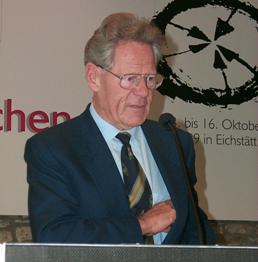
There will not be peace in the world if there is not peace among religions, says Hans Küng
William Delgado and ALC/Gospel Noticias, BOGOTA, Colombia, March 27, 2007
"There will not be peace in the world if there is not peace among religions,” Taxi Heathrow Airport said Professor Hans Küng during the Week of Ethics and World Peace that took place through Saturday, March 24, in this capital city. The theologian of Swiss origin, concluded by saying that it is necessary to accept a minimum ethics which should not suppose the dissolution of Christian ethics which is an ethics of maximums.
For Küng, an ethics of maximums such as the Christian can in any given moment represent a force for disagreement within the plural collectivity of a civil ethics. Acceptance supposes the tolerating of certain matters that Christians may consider as being an evil, but it should not mean the giving up of the maximums, or the impossibility of continuing with dialogue.
In addition, Küng pointed out that a Christian will live accepting a civil ethics of minimums, without giving up the proposing of his or her own ideals in the dialogue, at times in the form of a loyal disagreeing. Those who have pushed society forward have always been persons who have broken social consensus. The prophets have been persons who have broken consensus, bringing them into a confronting of the status quo. Such confrontation has often ended with the elimination of the prophet. But the ideas of the true prophets continue and in the end impose themselves. The future generations recover the figure of the prophet and even mythologize or canonize that figure.
It is precisely these prophets who carry the process of dialogue forward, because it never comes to a halt. For example, if nobody had broken the consensus, even today, Christians included, slavery would continue to be accepted. Jesus of Nazareth broke the religious consensus through his witness, service and weakness, and not through force and power. His example has been followed by many prophets who chose to denounce injustice through their service and non-violence: “For the Son of Man came not to be served but to serve” (Mark 10:45a).
“Today, we the believers of the different religions cannot continue to try and give answers to the urgent ethical matters from the standpoint of apparently unquestionable criteria and principles, fixed beforehand as if they have a validness situated beyond history. Even within the diverse Christian positions is it comprehensible to search for eternal solutions from the point of view of moral theology, making use of deductions resulting from an understanding of a universal and immutable human nature or essence,” said Küng.
The great religions have the conditions necessary for mobilizing people in favor of a planetary ethic: defining moral objectives, proposing instructions and criteria for action, motivating human beings both rationally and emotionally, so that the moral norms may be lived out in practice. In concrete terms, it is about advancing peace and reconciliation between peoples, supporting the demands of social justice and the care of the environment. This is possible because all true religion advances true humanity and, in a definitive way, seeks for men and women to behave in an authentically human way with their neighbor.
 Home
 Top
 Comment this article