
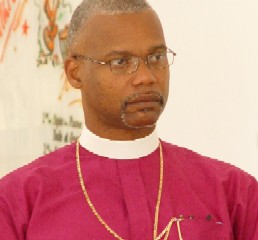
First African descendent President of CLAI
Interviewer: BUENOS AIRES, Argentina, February 27, 2007
JULIO MURRAY First African descendent President of CLAI
From: Pagina 12 by Washington Uranga
“The Taxi Heathrow Airport reconstruction will not depend only on the leaders but on the peoples.”
The Anglican Bishop, of Panamanian nationality, establishes the role of the Latin American Council of Churches (CLAI) in the processes of “new democracies.” In that sense he defines it as proclamation and accusation. He evokes the memory of Omar Torrijos and defends the electoral processes in Venezuela and Nicaragua.
This is the first time for an African descendent to be president of CLAI?
Yes. My ancestors are African descendents that arrived from Barbados and Jamaica with the construction of the railroad and of the Panama Canal. They brought with them their religious practice. I come from a family with Anglican Episcopal roots. The Anglican Episcopal Church has been in Panama for more than 154 years. My family is one of the founders of one of the congregations in the area of Río Abajo, Panama City. Today the Anglican Episcopal community in Panama is a national church, with a Panamanian face: not only the African descendents or the North Americans but also rural farmers and indigenous peoples and other cultures that live and have roots in Panama. We are a church that has a Panamanian face.
What does it mean to have a Panamanian face?
That the Episcopal Church in Panama is deeply rooted in the political and social problems, with a prophetic voice and presenting the Gospel in a way that can be seen and understood through concrete actions that promote life. A prophetic voice that teaches values whose practice has been forgotten. For example? Integrity, respect, inclusion versus discrimination and racism and exclusion, accompanying the search for salvation and health. Concrete things. The Panamanian face signifies that the church is not going to be against or outside of leaders who are going to emerge from Panamanian soil. My ancestors are African descendents, but I am one hundred percent Panamanian, which means to be Central American, Latin American. From that perspective we work out the Church’s mission and vision.
This generates tensions with social and political life. What is the level of relationships that the Church maintains with other political, social organizations?
From the sixties and seventies in Panama the Ecumenical Committee arose, first as a group of friends. The Archbishop of the Roman Catholic Church, Monsignor Marcos McGrath, and the first Panamanian Bishop of the Episcopal Church of Panama, Lemuel Shirley, were excellent friends and they began to invite other friends. Thus, in the dialogue, the Ecumenical Committee was forming and being forged, which accompanied different government decision-making processes.
Like what?
In the time of President Mireya Moscoso (1999-2004) we participated in the Truth Commission that had the responsibility to revise and to accompany the processes of militarization in Panama. Monsignor Shirley and Monsignor McGrath assumed the responsibility of accompanying the government in its decision-making and in the signing of the canal treaties. They had the opportunity to be participants and to accompany those processes. From the ecumenical movement, the Episcopal Church draws from the participation and accompaniment in very important decisions such as the one just mentioned related to the Torrijos-Carter treaties of 1977.
In your judgment, what does Omar Torrijos mean in the life of Panama?
The church has the responsibility to be the prophetic voice, without regard for who happens to be the head of state. With General Torrijos the Panamanian people consolidated a national project in regard to the sovereignty of the Panama Canal. All this began in 1964 with the murder of the students who wanted to raise the Panamanian flag in what was the “Canal Zone.” With General Torrijos that dream of sovereignty, really begun in 1977 and culminated on December 31, 1999, was consolidated. We entered the new millennium as sovereign.
What comparison or relationship can be drawn between Omar Torrijos and the current president, Martin Torrijos?
President Martin Torrijos is seeking to accompany the people in every process of development. If with General Torrijos the people were unified around a project of sovereignty, in these moments the people are seeking solidarity and to be unified around a national project. This does not mean only having the Panama Canal but to utilize in a more responsible way that which represents our situatedness or our geographical situation in the Americas and in the rest of the world. Development also passes through education, through justice, through the economy, but above all by seeing how this country and its development are maintained, promoting more and more services, but also local labor. The national project that we want in this moment with President Martin Torrijos involves a lot of participation from the citizen groups.
And it was not like this with Omar Torrijos?
Well . . . with Omar Torrijos you entered a public office and saw indigenous peoples, blacks, the common Panamanian. He did not make distinctions in that sense but gave people the opportunity of public access. But what Martin Torrijos intends is to invite organized civil society to the table for dialogue. Inviting also political parties – who have the option of participating or not participating at the table, private enterprise, church groups, the Ecumenical Committee, the professionals, the rural farmers, the common Panamanian, so that we can all participate in that dialogue.
Between Omar Torrijos and Martin Torrijos is General Manuel Noriega. There are many readings on Noriega. Which is yours?
There are as many readings as there are Panamanians. Some people see Noriega as the person who could control the drug addiction problem. At this moment Panama lives in a situation where that is controlled, but the feeling is that in the time of Noriega it was a lot more. Another reading of General Noriega is that he wanted to walk in the shoes of the general (Torrijos) but had another agenda. Another: he was the United States’s man in Panama. They trained him, they created him and when it was asked that they remove him they removed him.But I believe that General Noriega has represented for Panama a phase of history that our brothers and sisters in Latin America have also lived through: the epoch of militarism. It is a phase that we cannot avoid and much less forget, but to which we should not return.
Latin America lives in a moment of alternatives in political and social life. How does CLAI see this situation?
I perceive that at this time CLAI feels a clear challenge to accompany the churches during this new time in Latin America, understanding how to do mission and evangelization in a time so shaken by the birth of new democracies. It is a challenge, because there is a Word to proclaim, a message of life, a construction of the Kingdom that must be built. We cannot be mere spectators; we have a task to carry out. CLAI has to constantly revise itself, because we as church, we as agents of constant transformation of society, have to continue reading and re-reading from the situation in light of the Word of God. We are living processes of democratization, but we question ourselves as to why, instead of proclaiming and promoting life, concrete measures have not been achieved that truly are promoting life. There are many attempts. But there are other themes that worry us.
Like what?
The cases of corruption that we are confronting, the lack of practice of other values; we see ourselves in a situation in which the human being has been converted into an individual, into a number, and all that which relates to being a person and to being in relationship one with another has been left to the side. As well as that we matter to each other. Unfortunately it seems that only disasters unite us and call us to seek unity. The challenge laid out to our churches is how to do mission in the middle of that. CLAI wants to accompany, as a prophetic voice, these governments that are working in these new democracies. In some places, specifically in Panama, we say that the system has collapsed in its function of providing more and more opportunities. We must not patch up the system, but we must confront the system to say: enough of the corruption, enough of impunity. One must seek answers so that the people have confidence but also so that they have the possibility of having access to life. In many of our countries we have economic problems because unfortunately the pendulum of the external debt is still over us. Many of our countries are rich in human resources, in natural resources. But we speak of the distribution of the wealth. Totally uneven. The battle against poverty has to look at and to deal finally with how the wealth in our countries is distributed. CLAI has to collaborate with the churches in that agenda through their programs, proposing themes, so that the churches can efficaciously attend to that prophetic accompaniment.
Can we speak about Nicaragua? Are there two Daniel Ortegas? One of 1979 and the Sandinista Revolution and another of today?
As I said previously, the situation has changed. And perhaps the style of leadership has also changed. I do not believe that today the government of Nicaragua is withdrawn from all the efforts that are made in Latin America toward greater participation. Each context, each reality, requires its own analysis and its own answer. It has been very interesting to observe that Nicaragua and Venezuela, who have just had elections, have arrived at the decision that these are their leaders. This was done in a democratic framework of civic participation. There are those who are in agreement and those who are not, but I believe that each country is going to have the enormous challenge of responding from its reality. There are some things that are not apparent. For example, the fact that you participated from this model and now are participating from another. Can we trust you? This is from one side. Nevertheless I believe that the repair, the reconstruction, is not going to depend only on the leaders in the government, but on the capacity that the people have to be agents and creators of the history of our countries.
This can be translated into thinking more in the participation of the people than in the prominence of the leaders?
To think more in organized participation and that the opportunity can be given to generate the balance that is needed.
What is the process for the emergence of new leaders who are faithful to the base?
I believe that one of the fundamental elements is that there is access to education. Education in our countries is very important. Second, that there is access to work. I believe that the church makes a very large contribution when it teaches, from the faith, that it is possible to have new models. The value that the mission of evangelization has in these days is singular. Because the point of referral that we use is the Gospel. A Gospel that preaches peace, the search for justice, inclusion, relationships based on love and on respect toward the other. Those are the fundamental elements from which the people participate. The Church still is the voice of those who do not have a voice: women, indigenous people, the disabled, African descendents, young people, the family. These are the fundamental groups of our society.
The Church-State relationship is always troubled. What criteria are there to handle this?
I have mentioned time and again what it means to be that prophetic voice. And that prophetic voice has two components. Proclamation and accusation. We can proclaim because we know the Scriptures. But the accusations will be done in as much as and according to how we understand what is happening in the current situation. And that current reality always seeks a reflection in that which the Scriptures teach us. The task of the churches always is going to be a challenge. I believe that it is important that the Church can do the prophetic work without compromising the message of the Gospel. What are you referring to? I do not believe that the churches are called to be political parties. But, yes, we have a voice toward the ones that have the responsibility to give life-giving answers to the common majorities, that is to say, the politicians. I also do not believe that our task is to preach a Gospel of quick solutions that have nothing to do with the present, but that send you toward a future beyond the Sun. We are not called to build the Kingdom of God there, but in this reality in which we are conscious and walking. And in this reality to speak of a situation of prosperity is to reject the capacity of the grace of God in the midst of situations of despair, it is to reject the possibility of offering lights of hope. The challenge of the Church in accompanying the governments, the politicians, in accompanying the social reality, has to be more and more and more, in doing always the reading and the re-reading of what is happening in the situation and always looking in the Word and in the Gospel, the good news. And in every moment committing ourselves to being collaborators in the construction of the Kingdom, which already has been inaugurated, but has not yet arrived at completion. Because we as Christians, as churches, as Christian agencies that have faith in Jesus; we see where the lights are, the paths. And we cannot compromise the message of the Gospel, a Gospel that proposes life in abundance, that proposes relationships of equality, that proposes peace, the product of a system of justice in harmony with that search for peace.
What are the priorities that arise from CLAI for the action of the Latin American churches?
The contours are directed toward work with families, work with women, youth, indigenous and black peoples. But also functioning toward development, toward economy and society. We want to accompany the churches to help them be better interpreters of the social situation in which we are living and to be proponents, from the Gospel, of better testimonies that help to promote life. To definitively raise the aspect of the decade for peace in Latin America, an Afro-Latin-Indigenous America so convulsed and yet at each moment to be greater transforming agents for peace.
What does it mean, in two or three points, to be transforming agents for peace?
One: to seek first that our homes be places where we live together in peace. This does not imply the absence of difficult situations, of conflicts, but that they are handled in such a way that the result can be one which can be lived with. Second: that our congregations, our churches, also be an example of a living together in peace, where there can be participation, inclusion and where we are able, through the Word, to be a space of hospitality, of respect and of honor. And in the third place: the impact that the Church makes as it accompanies the governments, in the occasions of decision-making, in such a way that the message be a message founded in the Gospel. If we manage to do that we would be making a positive impact with a message that promotes peace.
 Home
 Top