
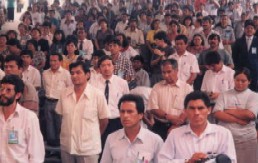
CHARISM, POWER, AND EVANGELICAL ETHICS
Dafne Sabanes and ALC/CLAI, BUENOS AIRES, Argentina, February 23, 2007
"Ministry, charism, and power" and "The church and ethical challenges" are two of the central Taxi Heathrow Airport themes being discussed in the Theological Forum during the sessions of the 5th Assembly of the Latin American Council of Churches (CLAI) that is being held in Buenos Aires, Argentina, February 19-24. The documents that provide support to the reflections of the Theological Forum were prepared based on discussions arising in the churches, organizations, and ecumenical groups that make up CLAI in the different regions of the continent.
In this interview, Pastor Juan Sepúlveda, a Chilean Pentecostal theologian, who participated in both sessions of the Forum, goes deeper into his perceptions about the questions presented in these discussions.
ALC: What concerns are there in the ecumenical churches around charism and power?
Juan Sepúlveda: My reading is that the evangelical churches have suffered a very strong blow of what occurs in the Pentecostal field, above all in the so-called apostolic movements, which has meant an extremely great challenge to the traditional ecclesiastic structures. For example, in Chile we are seeing that there are churches that have totally changed their structures starting from the ground up. Yesterday we heard in the plenary discussion concern because there are churches that do not use the Bible. Apostolic leaders arise whose leadership has a higher standing above traditional leadership, and this tends to replace teaching based on the Bible, with the consequences that come with this. All these situations, set before the traditional churches, signify a challenge that on the one hand is presented as a threat, which can affect the existence of that particular church, but at the same time as an attraction. It is an attraction to imitate styles in preaching, in the pastoral image, in the way of being church. There is fear and rejection, but also a yielding before this process of cultural-religious change. From the ecumenical churches then the need is seen to revise the meaning of words such as "charism" and "power" because they are used frequently in the environment of the new movements and Pentecostal, neo-Pentecostal, and renewal churches that are arising today. The main question is the question for ecclesiastical renewal. We live in a time in which renewal has become almost necessary for the survival of many churches, to the point that it might seem to be that a church that does not renew itself is a church that does not have a future. The question that would linger then is to be renewed with what ends, and what is more, in what way the identity, the history of the churches, and the message of Jesus Christ in this search for renewal is maintained.
ALC: Many times we find churches and new evangelical movement missionaries who hold seminars, conferences, and large meetings without mentioning God, Jesus, nor the Holy Spirit in the assembly, but speak of wars and battles. How is this tendency explained and what reflections are there about this topic in the ecumenical field?
Juan Sepúlveda: A vision of a very aggressive ministry exists, one that seeks power, and I believe that has little to do with what Jesus preached, with his ministry founded in the common people, women, the poor, children, the sick, with confidence in change and in justice, in spite of the powers that intend to dominate us. The predominance of these visions of mission challenges us to go deeper into the model of Jesus, a model that involves the whole community. The model of charism tends to place too much importance on the particular leaders to the detriment of the community, one that ends up lauding and praising its leader, but is not a priestly community. To rescue charisms, to remove the limits of emotionalism, and to situate them in the people who are integrated into the community without bias for its service is vital. Besides, these groups have produced a backward movement in the recognition of social changes, for example, in the recognition of the place of women in the ministry in the life of the church. But also it occurs with the youth. Or perhaps the only role that the youth can have in the churches is to take charge of worship, of singing, to play musical instruments? Or is there not another much more extensive field in which the youth can work in view of the challenges that they face daily? The same thing occurs with the indigenous question, where what is cultural passes for being quaint and demonstrated as such, and does not take into account the spirituality of the indigenous peoples nor their way of being Church. We could add the topic of the disabled, in which differentiated charisms exist and who also make valuable contributions to the life of the church. In the groups who worked on the documents, these topics have been clearly revealed, pointing at the need to count on churches that are inclusive and that contribute with a new model of life to society.
ALC: How do we arrive at a church where the faithful stop being mere receivers and comply with the call to the universal priesthood of all the believers?
Juan Sepúlveda: It interested me to listen one time to Emilio Castro in a discussion about this topic, in which he indicated that it is not a question of rejecting outright these new models of ministry, but to see in what way they arrive at the message of Jesus, not only from the rational. But it is true that there are congregations where the faithful have become mere spectators. The pastor becomes the shaman who has the power to change things, and the communities of faith lose the possibility of exercising their charism as healing, welcoming, participatory communities. It is important to take from the new movements that which can enrich our churches, with a biblical and also a sociological discernment. Renewal is important, but we might remember that we received the Gospel of Jesus two thousand years ago. And it is that word that we should continue interpreting to make it relevant in our time. One must maintain that tension between the Good News, announced centuries ago, and its meaning in this moment.
ALC: The growth in the number of churches has made many leaders think of the possibility of achieving political power. What are the concerns of the ecumenical churches about this topic?
Juan Sepúlveda: In the meeting of the Andean Region of CLAI, that developed the document about “Ministry, charism, and power,” this topic was discussed a lot. Critical voices regarding the temptation of power were heard. There were those who recalled that from the evangelical ranks, the bond between the Roman Catholic Church and political power was historically criticized, that which exists from colonial times. But at the same time a temptation to copy the same model is seen. There are those who maintain that we can do it because the evangelicals are better, we have the pure Gospel, and that because of it we should achieve political consequence. There is an aspiration to occupy this place in society and to tell the politicians how they must do things. In the face of this, there are those who they say that one must be careful with the temptations of power. But also there are the ones who maintain that if we remain fearful without speaking nor acting we will be evading a field in which there can also be place for Christian testimony. The questions around this are linked to how to enter this field, above all knowing that the evangelical and Protestant churches have a very strong tradition of the separation between Church and State. It is said then to think of power as service with powerful reminders that the interests of the community are first, assuming civil service and political action with that perspective. We should understand also that politics has its dynamic, that negotiation is inevitable, and that we cannot enter it ingenuously.
ALC: How would evangelical or Protestant ethics play out in all of this?
Juan Sepúlveda: I believe that what is important is that churches intervene in the great discussions that are being held in our region currently, bringing to light that in having different opinions we can speak with one voice when necessary, and that we assume to be a voice among others, something that takes the Roman Catholic Church a lot to accept, for example. We have to try to persuade the authorities, politicians, social leaders, and all of society with our contributions, whose validity is given through its foundation and through who we are, not because we claim to speak in the name of God. I believe that we should contribute to the construction of a pluralistic society, one that respects and values diversity. When we speak of ethics, this is crucial.
 Home
 Top
 Comment this article