
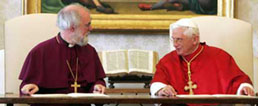
The Pope and the head of the Anglican Church acknowledge the difficulties of ecumenism
VATICAN CITY, El Vaticano, November 23, 2006
40 years after Pope Paul VI and Archbishop Michael Ramsey met and began a new Taxi Heathrow Airport
journey toward reconciliation between the Catholic and Anglican Churches, Pope Benedict XVI and the Archbishop of Canterbury, Rowan Williams, head of the Anglican Church, met again and signed a common declaration. In the declaration they acknowledge the difficulties of the ecumenical journey, but at the same time emphasize the need for the protection of life, from conception until natural death.
The declaration states that “our long journey together makes it necessary to acknowledge publicly the challenge represented by new developments which, besides being divisive for Anglicans, present serious obstacles to our ecumenical progress,” and continues, “It is a matter of urgency, therefore, that in renewing our commitment to pursue the path towards full visible communion in the truth and love of Christ, we also commit ourselves in our continuing dialogue to address the important issues involved in the emerging ecclesiological and ethical factors making that journey more difficult and arduous."
According to both leaders, the matters in common that call for closer co-operation are: “the pursuit of peace in the Holy Land and in other parts of the world marred by conflict and the threat of terrorism; promoting respect for life from conception until natural death; protecting the sanctity of marriage and the well-being of children in the context of healthy family life; outreach to the poor, oppressed and the most vulnerable, especially those who are persecuted for their faith; addressing the negative effects of materialism; and care for creation and for our environment.”
Following the meeting, international attention centered on the ordination of women to the priesthood in Anglican communities, homosexual unions, and the matters of abortion and euthanasia. Despite the differences, both committed themselves to dialogue and manifested their desire to continue along the path of “true ecumenism.”
Source: Zenit
 Home
 Top