
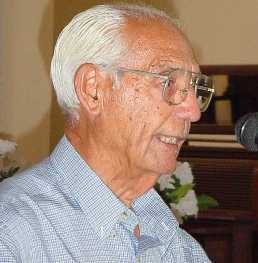
Death of Pastor Cepeda is a lamentable loss in Cuba
HAVANA, Cuba, November 13, 2006
From his youth, Cepeda stood out as a dynamic and deeply intellectual person, and was Taxi Heathrow Airport President of the Presbyterian Youth of Cuba. Being president enabled him to establish contacts with young people of other denominations and the founding of the Evangelical Youth Federation of Cuba. That way he began a number of ecumenical projects with which he was involved during the greater part of his life.
In 1941 in Lima, Peru, Cepeda was one of the founders of ULAJE (Latin American Union of Evangelical Youth). As a result he developed unbroken friendships with other continental ecumenical leaders, as is demonstrated by his correspondence with Alberto Rembao, Luis Odell and others. Because of that Emilio Castro recently wrote the prologue of a book that includes many of Cepeda’s writings.
Later on, Cepeda did post-graduate studies in Christian Education in Chicago and returned to Cuba to direct that ministry for the Presbyterian Church. When the Evangelical Theological Seminary in Matanzas was founded in 1946, he became a member of the faculty while at the same time furthering his own studies as part of the first graduating class. He then completed his Doctorate in Teaching at the University of Havana.
That is when he began his pastoral ministry, serving in different places such as Santa Clara, Varadero, and the Second Church of Matanzas located in the Versalles neighborhood. He served there for a number of years until becoming Executive Secretary of the Presbyterian Cooperation Commission for Latin America (CCPAL), precursor of AIPRAL (Alliance of Presbyterian and Reformed Churches of Latin America). In that position, Cepeda prepared study materials that are still used today throughout the continent.
When the crisis of the exodus of pastors occurred following the Cuban revolution, Cepeda resigned from his position with CCPAL to return to the pastorate of the church in Versalles. Years later he assumed the pastorate of the Reformed Presbyterian Church of Luyano, located in Havana where he finishes his ministry as a pastor. A prolific writer and careful user of the Spanish language, he wrote many books on themes as different as Christmas and ecology.
An untiring writer, Cepeda wrote hundreds of articles for magazines in Cuba and abroad. Some of his articles, particularly those that had to do with the social reality, caused heated debates which he never avoided, always maintaining a high level of respect and chivalry.
After having retired, Cepeda devoted himself to historical studies, both secular and ecclesiastical, publishing various books such as Notes for a History of Presbyterianism in Cuba, considered to be obliged reading on the history of Protestantism in Cuba.
His ecumenical activities had him hold positions on various occasions both in Cuba and abroad. During the 1960’s he was President and also Executive Secretary of the Council of Evangelical Churches of Cuba, as well as a director of ISAL (Church and Society in Latin America). He was a dreamer yet at the same time a visionary of great creativity.
At his initiative during different moments of his life, a number of projects came about such as: the MENSAJE (Message) magazine of theological writings; the SU VOZ (His Voice) devotional readings; the teaching chair of Church and Society in the Matanzas Seminary; the founding of CEHILA Cuba (Commission for the Study of Church History); the Study Center of the Council of Churches, and lastly; the Institute of Biblical and Theological Post-graduate Studies (ISEBIT).
One of Cepeda’s greatest contributions was the so-called Plan for the Advancement of Presbyterianism in Cuba, implemented from 1960 to 1965 and which has left deep marks on that church.
He was a regular speaker at events organized by the Christian Student Movement, ULAJE, the Christian Association of Young People, and CLAI (Latin American Council of Churches).
He always kept his loyalty to the Lord Jesus Christ, his church, the ecumenical movement and his country. Although gifted with great intelligence and skill, he never considered it unbecoming of him to carry out simple tasks, if they were for the good of his neighbors.
Now in the eternal presence of God, Rafael Cepeda Clemente leaves a permanently indelible mark on the church, not only in Cuba but also in Latin America.
 Home
 Top