
Chilean Evangelical Church celebrates its first National Day
SANTIAGO , Chile, November 6, 2006
The National Day came about as a result of former President Ricardo Lagos’ issuing of Taxi Heathrow Airport Legal Decree 142, setting October 31 as the National Day of the Evangelical and Protestant Churches, in recognition of the important work carried out by the congregations in the interior of the country and the continuing work throughout the history of Chile. This decree by which the State recognizes the importance of the Evangelical Church is unique in Latin America. October 31 was chosen because it is a day of commemoration shared by all the Evangelical people, being the beginning of what is historically known as the Protestant Reformation.
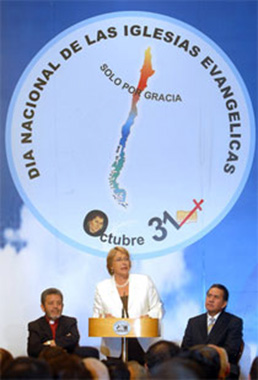
Michelle Bachelet, the President of the Republic, pointed out that “this is the first birthday of the Evangelical Church and it is being celebrated in La Moneda, the residence of the Presidents.” Present at the official ceremony were some three hundred leaders and pastors representing the various Evangelical denominations. President Bachelet expressed her recognition of the devotion and good will of the men and women who through their lives had in the past been an important witness to the country.
In emphasizing that the Evangelical Church represents pertinent values such as respect, universality and diversity, Bachelet said that, “This is a significant day for hundreds and thousands of Chileans,” and added, “It is not important for Evangelicals only, but for all of Chile also.” She then committed herself to there being an Office of Religious Affairs that will facilitate the church’s work of evangelization in all the country.
Bishop Gloria Rojas, President of the Evangelical Lutheran Church in Chile and in charge of the October 31 Commission of the Extended Work Group of Evangelical Organizations (Committee of Evangelical Organizations, Council of Historic Churches, Confraternity of Christian Churches, Council of Pastoral Units of the Metropolitan Region, National Evangelical Council of Chile), said that “this occasion is a historic and international recognition.” She mentioned various worldwide organizations that had sent their greetings on the occasion of this official celebration, among them the Latin American Council of Churches (CLAI) and the Evangelical Churches in Germany.
Bishop Emiliano Soto, Moderator of the Extended Work Group of Evangelical Organizations and President of the Council of Pastoral Units of the Metropolitan Region (CUPREM), gave a historical account in which he emphasized the work of various brothers and sisters who had contributed to the country’s history. He underlined also the church’s role in defense of the freedom of thought and conscience.
For their part, some five hundred youth gathered together in the Plaza Italia to celebrate the event, this square being traditionally a place where different sports victories are celebrated. The groups that organized the gathering were, “Young Christians for Chile,” the “Federation of Christian Students,” the “Paths Corporation,” and, “Jumep.cl.”
Musical bands of different styles conveying a motivating message set the tone for the gathering that showed the diversity of the Evangelical youth. The organizers pointed out that the main objective had been achieved, namely that of an open air celebration of a historic occasion and showing society that motivated young people who can make a contribution to it do exist.
“We wanted to motivate our young people to publicly commit themselves to continue contributing Christian values to our country. Along with that, we recognized the important work of men and women who in the past sowed everything, including giving their lives, so that today it be possible to live out this ‘important harvest,’” explained Jessica Ramírez, member of the communications team that organized the gathering.
The National Day was supported by the Government of Chile through the National Council of Culture and the Arts, the United Nations Organization for Education, Science and Culture (UNESCO), and World Vision.
 Home
 Top