
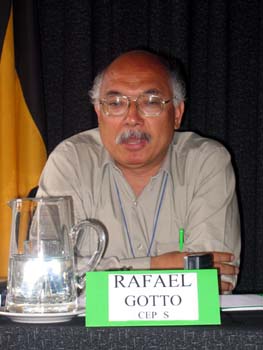
A great challenge: Evangelicals on the Anticorruption Council
LIMA, Perú, October 24, 2006
The National Anticorruption Council has been a part of the Peruvian government for a number Taxi Heathrow Airport of years but it has not been easy to effectively enforce it. As Goto himself explains it, “the institutionalizing of the National Anticorruption Council is an important step taken by the present government, so as to guarantee transparency in the management of the public administration, confidence in the public and social institutions, and the strengthening of democracy. With regard to this aspect significant efforts have been made in the past, nevertheless, the problem is very complex and vast, and so demands the permanent attention of the state and the civil society, and that it also be given a permanent place on the public agenda.”
In a country with a level of corruption that has not declined, participation on the council by different institutions may represent a new way of seeing things. According to the 2005 report of the Pro-Ethics agency of Peru and Transparency International, the country has the Latin American average of 3.5 out of a possible 10, with 0 being the highest level of corruption.
"In this sense,” says Goto, “the presence and participation of the churches on the council has a significance that goes beyond particular ways of seeing things. The purpose is not that the churches, Roman Catholic or non-Roman Catholic, influence the discussions and actions of the CNA with a moral and religious perspective. The institutional, structural, political and social dimensions of the problem need to be dealt with. In that sense, as churches we can also contribute and show why we have been appointed to the council.”
As Pastor Goto Silva is the President of the National Evangelical Council of Peru, his presence on this important government body is seen in terms of the Evangelical churches having been jointly named, and as a challenge rather than a privilege. “It is a time for us to leap forward, forgetting about thinking and doing things out of a concern for our survival or institutional development, toward thinking and acting for the wellbeing of the country,” says Goto.
Goto emphasizes that “as Evangelical churches we have more and more opportunities opened to us to contribute to the country. This appointment needs to be seen as being an extension of what has already been achieved through the National Agreement Forum, the Round Table for Coordinating the Fight Against Poverty, among others, where the Evangelicals are being summoned. That is why our participation as Evangelicals implies that we are called to do it well, by offering concrete proposals.”
Goto, in addition to being the President of the National Evangelical Council of Peru (CONEP), is also the General Secretary of the Pilgrim Evangelical Church of Peru, the General Director of the Ecumenical Center for Social Development (CEPS), and facilitator for the Ecumenical Regional Center for Advice and Service (CREAS) in this Andean country.
 Home
 Top
 Comment this article