
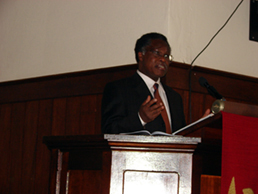
The ecumenical movement needs to hear the voices of the South, says Kobia
PORTO ALEGRE, Brasil, October 18, 2006
In a brief visit to Brazil invited by the Evangelical Lutheran Confession Church (IECLB), Samuel Taxi Heathrow Airport Kobia, General Secretary of the World Council of Churches (WCC), spoke in defense of the changes occurring in the ecumenical movement.
In an interview with Edelberto Behs of ALC, Kobia praised the courageous modifications taking place on the ecumenical scene, which are bringing into the center of the movement’s agenda players who are beginning to make their voices heard, such as women, youth, persons who bear deficiencies, and the indigenous peoples.
“I strongly guarantee that the time has come for a new era of ecumenism in the world,” Kobia said. Stating that ecumenism in the XXI century must accept that the situation has changed, he continued by saying: “Because of that we need other ways to organize ourselves, including the form that the ecumenical movement is to have, in which spirituality will have a more central place.”
Kobia advised that the ecumenical movement needs to hear the voices coming from the South. He spoke in defense of a spiritual ecumenism turning toward the youth, in which they can find meaning to life, and he wants the WCC to make it possible for Latin American boy’s and girl’s choirs to perform in other regions of the world, singing songs of peace and drawing messages about the overcoming of violence.
Kobia had been in the city of Panambi, 380 km to the northwest of Porto Alegre and toward the border with Argentina, where the IECLB’s Council met from October 12 – 15. Speaking quietly and slowly, and wearing a dark suit despite the heat, the General Secretary pointed out in the interview small steps that had been taken forward in the relations between the WCC and the Vatican, and regretted the decision of the Methodist Church in Brazil to remove itself from those organizations in which the Roman Catholic Church is present.
 Home
 Top
 Comment this article