
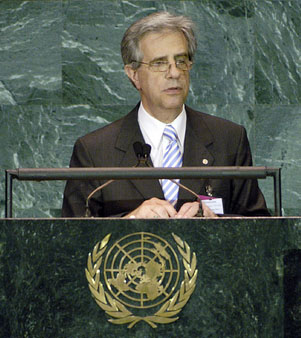
Evangelical leaders are received by the President
MONTEVIDEO, Uruguay, October 13, 2006
According to information from the Communications Department of the Methodist Church of Uruguay (IMU), the Taxi Heathrow Airport President of the country, Tabaré Vázquez, received a delegation from the Federation of Evangelical Churches of Uruguay (FIEU) on the occasion of the fiftieth anniversary of this the oldest ecumenical organization in the country.
The delegation from the FIEU was made up of the presidents of the member churches: Oscar Bolioli, Methodist and President of FIEU; Hugo Armando Pilón, Waldensian; Wilma Rommel, United Lutheran; Federico Schaffer, Evangelical Church of Río de la Plata; Obed Boyadjian, Armenian; Samuel Flores, Rising Pentecostal and Bartolo Aguirre, Salvation Army.
Following the protocol greetings, President Tabaré Vázquez set the tone for the gathering to be a cordial, pleasant and relaxed one, by quickly picking up on matters of common interest, and the meeting extended beyond the 30 minutes established by protocol. Those present had had the feeling that the conversation would take place within such an atmosphere, because FIEU’s request to meet with the President had been granted the day after being presented, and the delegation of seven persons was accepted when normally the President does not receive any larger than five.
Among the matters raised was the delegation’s willingness to have the churches support programs of social action. The President responded with an open welcome to the proposal, indicating the importance of the support that the churches are able to give to such programs. He also included programs that can bring about a “productive country,” while at the same time pointing out the valuable experience of the churches for that.
Concerning voluntary service which is inherent to the churches, the delegation raised questions about the present situation of such service at the government level, because there are in Parliament proposals for legislation on the matter. President Vázquez explained the current state of the debate and offered words of ease, stating that as long as there is no legislation on voluntary service the churches can continue to develop theirs, as they have done so up to the present time. He further explained that the purpose of the law to be proposed is to avoid abuses.
Another concern that the delegation had was that of “support received from outside the country.” The concern had to do with the cumbersome difficulties and long bureaucratic proceedings involved, when organizations or persons send from abroad different kinds of help in the form of clothing, school materials and others, causing them to refrain from helping. Tabaré Vázquez recognized that the current proceedings are long and annoying, and that more expeditious means need to be found. The President asked the churches to offer concrete proposals that will help implement more expeditious means, including consideration of how support received from abroad is dealt with in other countries.
As the gathering with the President had moved along so well and even though it had not been included on the original agenda, the matter of the tension between Uruguay and Argentina over the pulp mills on their border was brought up. With regard to this matter, as with the previous, Tabaré Vázquez showed that he was aware of the actions undertaken by the churches and expressed his gratitude for what they were doing through prayer and dialogue on both sides of the border, with regard to the human tensions.
Another matter, raised by the President without any prior preparation, had to do with the forming of a commission on the respect of minorities. The President asked the FIEU to propose names to be considered for such a commission.
Tabaré Vázquez also indicated his willingness to preserve the lay status of the state and the guaranteeing of dialogue with all religious sectors.
For the members of the delegation the gathering was “a serious, opportune dialogue, with various moments of good humor, and which allowed matters for future work and collaboration to be raised.” The President strongly and sincerely stated that the doors are always open to the churches, and asked that they pray for him and the work that he has ahead.
At the end of the gathering, the Presidents of the Evangelical Churches gave the President of the country a Bible in remembrance of the occasion. Never before had the FIEU been received by a President of Uruguay.
 Home
 Top
 Comment this article