
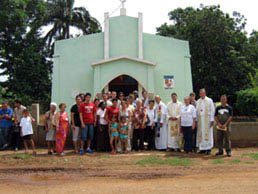
Episcopal church celebrates its centennial anniversary
José Aurelio Paz, Cuba, October 10, 2006
The Feast of Saint Michael and All Angels, which in the calendar of the Episcopal Taxi Heathrow Airport Church falls on September 29, was the occasion for celebrating the centennial anniversary of a rural church bearing that name, in the town of Ceballo, of the Province of Ciego de Ávila in the center of Cuba.
At the celebration, which was presided over by the Bishop of the Episcopal Church of Cuba, the Right Reverend Miguel Tamayo Zaldívar, the Reverend José Ángel Gutiérrez who pastors the Church of St. Michael and All Angels, expressed that, “We are a small community of faith that perseveres in serving Christ and which draws inspiration from the example of all the faithful Christians who have gone before us.” Gutiérrez also asked God for the necessary strengthening in the faith and ministry.
Present at the event were members of the Episcopal clergy, the Bishop of the Roman Catholic Church in Ciego de Ávila, Monsignor Mario Mestril Vega, local Evangelical pastors, and officials of the Communist Party and the Registry of Associations, which have to do directly with religious matters and relations with the state.
The occasion was also appropriate for the ordination to the diaconate of Armando Delgado Orozco. In the sermon to the ordinand, Episcopal priest Iván González Taissé spoke of the diaconal vocation as exemplifying the unavoidable Christian principle of service.
The rural town of Ceballo takes its name from a wealthy Cuban, José Manuel Ceballo, who, along with a North American, George H. Guillet, and a Spaniard, Manuel Silveira, began various businesses in the region toward the end of 1905, most importantly the growing of orange citrus fruit. It is said that around that same time hundreds of immigrants from the English speaking Caribbean islands, who had come to Cuba in search of better economic conditions, had arrived in the region. Many of them were practicing Anglicans who began missionary work which has been maintained throughout the century, although with ups and downs.
According to what is said in a historical account prepared for the occasion, even though the missionary work began in 1906, the first church building was consecrated in June of 1928, and located in the poorest part of the town. The congregation grew into having a large membership which suffered its first numerical decline as a result of the Cuban sugar industry’s economic crisis in 1920, which made many of the Caribbean immigrants return to their home countries.
In August, 1950 the Rev. Maximiliano Salvador Fonseca, the community’s new pastor, considered moving the church building to a different area in Ceballo, the area where the present building is located, with the purpose of facilitating a greater attendance. The new church building maintained the architecture of the former building and was consecrated on June 29, 1952 with a service of dedication.
With the coming into power of Fidel Castro in 1959 and as a result of the inherent contradictions at that time between the Cuban ecclesiastical hierarchy and the new revolutionary government, the congregation’s membership experienced different kinds of involvement. The work was slowly recovered, even though its aged wooden building had over time fallen into a state of complete ruin.
On June 29, 2000, 48 years after the dedication of the former church building, work was begun putting up the walls of the present concrete building. The building was completed in February, 2003 and consecrated by Bishop Tamayo on August 21, 2004.
Even though the Cuban Episcopal Church also suffered a massive exodus of many of its clergy to the United States at the beginning of the revolution, today as part of the so called historic churches, it is carrying out its ministry in an open commitment to the Cuban people, and in faithfulness to the roots that support its own identity.
 Home
 Top
 Comment this article