
Neoliberal market lacks mind and soul, said Finance Minister
Nilton Giese, QUITO, Ecuador, June 16, 2005
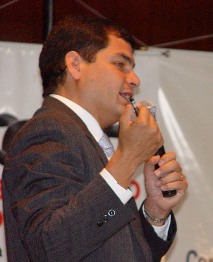
Ecuadorian Finance Minister Rafael Correa was harshly critical of the terms of the foreign debt Taxi Heathrow Airport imposed by creditor nations against impoverished countries in the region and said that the neoliberal market "lacks mind and soul."
Correa said that the "best guarantee" that the foreign debt is paid is to not impede the development of debtor nations, however, he said that the excessive conditions that are imposed on those nations condemn them to stagnation and poverty.
The Finance Minister spoke at the inauguration of the II Ecuador Encounter, held this Wednesday in this city with the participation of more than 100 local representatives from different organizations and Churches.
According to Pastor Israel Batista, secretary general of the Latin American Council of Churches (CLAI), the event aims to profoundly address the issue of the foreign debt to find consensus-based solutions."
The event is part of CLAI's Faith, Economics and Solidarity Program, coordinated by economist Franklin Canelos, with the participation of the Latin American Institute of Social Investigations (ILDIS), the Ebert, Foundation, Jubilee 2000 - Guayaquil Network and the financial support of the Swiss Bread for All Organization.
Minister Correa said that in Ecuador, for every dollar that is spent in the national budget, 34 cents correspond to the foreign and national debt service payments. He said that his country spends 6 percent of its gross domestic product making interest payments.
He said that the figure is equivalent to 43 percent of the current income, which is counterproductive "while some other studies warn that to use more than 3 percent of the GDP for foreign debt payments means condemning the country to socio-economic stagnation."
"Prioritizing the foreign debt payments means cutting social investment," he said. According to Correo, Ecuador spends a tenth of what countries like Argentina, Uruguay and Brazil earmark for social spending.
The economic figures presented during the event speak for themselves. Ecuador currently has the same GDP it did in 1980. Ten percent of the upper class enjoys 45 percent of the wealth while the 10 poorest percent have access to 1 percent. Worker salaries have remained frozen since 1998.
Sixty percent of the Ecuadorian population lives below the poverty line with little or no access to education, adequate nutrition and signified housing. Eighty-seven percent of the indigenous population is poor and of those 50 percent are extremely poor. Each year more than 100,000 children cannot go to school because there are no schools.
"If there is no social investment, these figures will not improve," said economist Alberto Acosta of ILDIS. "In 2005 the foreign debt payments represented 109 percent of social spending," he concluded.
Correa's proposal, shared by many speakers at the event is to apply a new strategic vision to the economy, with fiscal transparence and a new set of priorities, placing investment in health and education before the foreign debt payments and diversifying funding sources.
 Home
 Top
 Comment this article