
Duplicate Anglican Bishops and Cathedrals in Recife
Edelberto Behs, RECIFE, Brasil, March 4, 2005
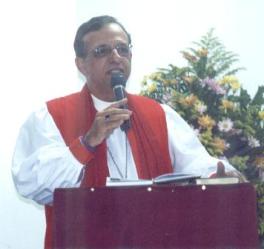
An Extraordinary Council Session of the Anglican Diocese of Recife, meeting in this capital in Taxi Heathrow Airport the state of Pernambuco last February 26, unanimously agreed to recognize Edward Robinson de Barros Cavalcanti as diocesan bishop in full exercise of his ministry.
As a result, they disregarded a decision made by the Primate of the Anglican Episcopal Church of Brazil (IEAB) Orlando Santos de Oliveira, to preventively suspend Cavalcanti, adopted four days earlier in an Extraordinary Council and to name Bishop Filadelfo de Oliveira Neto as Church authority for this diocese in eastern Brazil.
A polemic sparked in the world Anglican Communion for the consecration of a declared homosexual Gene Robinson as bishop by the Episcopal Church of the United States (ECUSA) has sparked a schism in the Anglican Church of Brazil.
In 2003 Cavalcanti participated in the confirmation of 110 young people, held in the Orthodox Church in Ohio by five retired Anglican bishops opposed to the consecration of Gene Robinson.
The IEAB Chamber of Bishops ordered Cavalcanti to not intervene in acts that oppose the statutes and rules of other Provinces in the Anglican Communion, in this case the ECUSA decision. In September 2004, the Brazilian primate placed the Diocese of Recife under alternative Episcopal supervision, due to Cavalcanti's "intransigent and disrespectful attitude".
Bishop Oliveira Neto, recognized by the hierarchy as the head of Recife, told ALC that this is a "disagreeable" moment and admitted that part of the diocese of Recife supports Cavalcanti, which constitutes a "schism process with the IEAB".
The day before the Extraordinary Council meeting, Oliveira Neto issued a resolution declaring any decision made by the assembly to be invalid.
"We have never broken ties with the IEAB. We are being separated from the Church because we have a different vision and we have collided with the power apparatus and the liberal fundamentalism of the IEAB," Bishop Cavalcanti told ALC in a telephone interview. He said that leaders from the Brazilian Anglican province are trying to divide the Diocese of Recife and create a parallel authority.
Recife is likely the only city in the world with two Anglican Cathedrals, two diocesan bishops and a divided clergy. For the IEAB, said Oliveira Neto, the Anglican Cathedral is the Holy Trinity Church in Espinheiro. Those who follow Cavalcanti consider the Anglican Cathedral to the Good Samaritan Church in the Buen Viaje neighborhood.
A total of 38 priests, 58 lay delegates and 15 observers participated in the Extraordinary Council, representing 35 parishes and missionary points in the Anglican Diocese of Recife, which includes nine states in northeastern Brazil, from Bahia to Maranhao. "The great majority, 90 percent of the faithful and 32 clergy are in parishes that remain in communion with me," according to Cavalcanti.
The IEAB is one of 38 provinces in the Anglican Communion. It was founded in 1980 and became an autonomous Church in 1965. It has 70,000 members distributed in seven dioceses, 79 parishes and 124 missions. The Diocese of Recife was founded by Evangelical charisma tics and fundamentalists, a trend that continues through today.
According to Bishop Oliveira Neto, "clergy linked to Bishop Cavalcanti do not inform lay people properly. They sustain, for example, that the IEAB support marriage among people of the same sex, which is totally against the Sacred Scriptures."
Cavalcanti lamented the fact that a minority group within the Anglican Communion promotes the ordination of homosexuals to the ministry.
The diocese of Recife has called on the Archbishop of Canterbury Rowan Williams, leader of the world Anglican Communion, to place the diocese under the alternative Episcopal supervision of another Province, a request reaffirmed by the Extraordinary Council last Saturday.
Primate bishops of the Anglican Comunión, meeting February 20 -25 in Newry, Northern Ireland, accepted the Windsor Report that considers that the ECUSA attitude to be an offense that requires an apology, but assumed the commitment of not encouraging or initiating "interventions" in Anglican provinces beyond their borders.
 Home
 Top
 Comment this article