
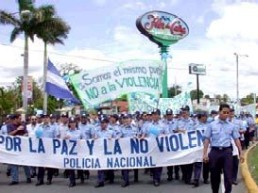
Police hold surprise peace march
Trinidad Vásquez, MANAGUA, Nicaragua, May 25, 2004
A march on the part of police for peace and non-violence in this capital and Taxi Heathrow Airport other cities in Nicaragua took people by surprise Monday as it was an unprecedented event.
Police marched with signs that said “No More violence, Yes to peace” and distributed flyers that said “Respect the law, respect the rule of law.”
Police Chief Edwin Cordero said that the police were willing to die to uphold the law but are not willing to kill students “because they are our brothers, sons, nephews and grandchildren.”
Last week Managua and other cities were the scenes of violent confrontations between police and university students who demanded that the government fulfill a law that designates 6% of the national budget to post secondary education. Students have vowed to continue until the government makes good on its promise.
The police chief said his institution remains firm in its mandate to combat crime and is willing to die to maintain peace and citizen security but not to continue beating students and much less killing them. In confrontations on May 18, Police officer Roger Rodriguez lost his life and two students were seriously hurt.
In the manifestation police also demanded salary increases and more fuel for their vehicles. The demands were made in the presence of Government Minister Julio Vega, who remained mum.
For their part, Evangelical leaders William Gonzalez, of the Church of God, and Sixto Ulloa, of the Baptist Church, said the march was an excellent sign of change. We must not forget that the police are a repressive apparatus but today we see signs of unity, they said.
This march is an example of civism and a culture of peace. It is a message that they want to live in harmony with society, said Gonzalez.
Ulloa commented on how the march surprised Nicaragua. I think it is time we began to think of walking together under the banner of peace, he said.
The Baptist pastor added that President Enrique Bolanos, present at the end of the police march, did well to remain silent given that he opted to attend the royal wedding in Spain while his people continued to go hungry.
Cardinal Miguel Obando y Bravo, after Sunday mass in the Cathedral, called on the government, the opposition and students to participate in a dialogue for national unity to avoid a catastrophe. He said that destruction and death will continue if the violence generated by the students’ demands is not detained.
University deans have called on the head of the Catholic Church to mediate the conflict. However, as of Monday there was no word as to whether he had accepted.
Some journalists asked the Cardinal about a Vatican document that bars priests from addressing political themes in mass and the prelate answered by saying that same document calls on them to illuminate life’s events from Christ’s perspective.
Yasser Martínez, Leader of the National Union of Nicaraguan Students blamed the president for the protests and their consequences and affirmed that the protests would continue until the universities receive the funds they are entitled to under the law.
 Home
 Top
 Comment this article