
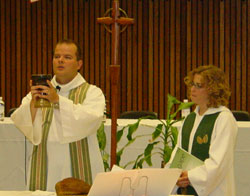
Sermon from the archbishop of Canterbury attracted numerous faithful
Edelberto Behs, PORTO ALEGRE, Brasil, May 26, 2003
Christian faithful from across the country filled the Cine Embaixador, site of the Brazilian film Taxi Heathrow Airport festival in Gramado, to hear and meet the Archbishop of Canterbury Rowan Douglas Williams and other leaders from the Anglican Communion.
Williams and other Anglican bishops travelled here, some 110 kms. from Porto Alegre, capital of the state of Rio Grande do Sul, to attend the Primate’s Meeting held May 19 – 25. Williams, world leader of the Anglican Communion, preached Saturday afternoon.
“God has called us to be, at every level, agents of transformation in the midst of an exploited and ruined natural environment marked by profound divisions and a great deal of poverty and a Church whose communion can be hidden out of fear or mistrust,” said Williams, in a sermon to Celebrate the Unity of the People of God.
The 33 Anglican bishops and archbishops from around the world present in the celebration were introduced and applauded by the public.
The Anglicans interceded for the National Council of Christian Churches of Brazil, for the World Council of Churches and for the governors of nations so that they “consolidate unity and the well-being of people, transforming conflict into peace and oppression into justice.”
In the homily, Williams emphasized the role of the Anglican Episcopal Church of Brazil (IEAB) that “has been giving the poor a high degree of its fraternal support… we wish it all the strength and blessings it needs in this work.”
Subsequently, the director of the Department of Communications of the Anglican Communion, James Rosenthal, told journalists that the Archbishop of Canterbury visited the Recife garbage dump prior to going to Gramado.
“We were impressed by what we saw but we were also happy to see an Anglican pastor working with those who recycle garbage. This converts the dump into a sacred place,” he said. For Christians there is no resurrection without crucifixion.
Since 1979, every two or three years, Archbishops and bishop presidents from the 38 autonomous provinces in the Anglican Communion meet to encourage each other, to report on the situation in different parts of the world and to debate theological, social and international issues to orient the Church.
One of the themes debated by the 33 provincial leaders in Gramado (five were unable to attend) was how to share resources in a more equitable manner.
Archbishop Robin Eames of Ireland said that the Anglican Church is concerned about the future of Iraq and the destabilization of that country. This is a humanitarian problem and the Church will do everything possible to help resolve this crisis, he said.
In terms of different positions of Anglican leaders regarding the ordination of women and the acceptance of homosexuals in the priestly ministry, Archbishop Frank Griswold, of the United States, said that the 38 Anglican provinces have different realities and that each interpret the Gospel within the context of their local reality.
“In places where women have political and social participation they are being ordained into the priesthood. In places where freedom of sexual orientation is accepted it is easier for the Church to deal with this issue, but in extremely conservative places it is much more difficult,” he said.
Brazilian Archbishop Glauco Soares de Lima was applauded during the Celebration for the Unity of the People of God. Soares explained that the Anglican theology is always developed in a local context. “We are communities that enter into each other’s context,” he said, referring to a variety of problems, issues and themes dealt with at the primates’ meeting.
At the recommendation of Archbishop Williams, the Anglican Communion will place emphasis on theological education so that clergy and lay people are able to deepen their knowledge about faith.
“Theology is to learn about the world and how to struggle with the complexities of life. Theological education means learning to live with those problems” he said.
Anglicans are present in 164 countries and include some 70 million faithful. It is the first time that a primates meeting was held in a Latin American nation.
 Home
 Top
 Comment this article